Benoit Mandelbrot, the father of fractal geometry passed away on Thursday.


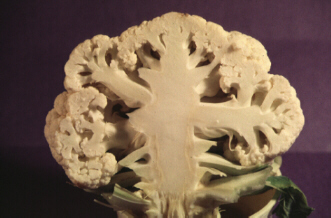
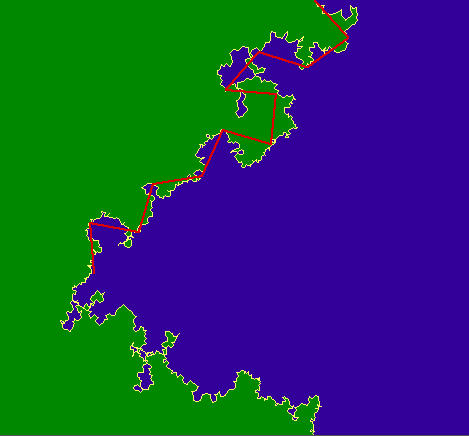
He was a French-American mathematician, who explored a new class of mathematical shapes known as ‘fractals’. His main works, Fractals: Form, Chance and Dimension and The Fractal Geometry of Nature, were published in 1977 and 1982. He argued that what might be seen as random mathematical shapes in fact followed a pattern if broken down into a single repeating shape and that irregular mathematical shapes were a reflection of nature. The concept has been used to measure previously immeasurable objects, including the coastline of the British Isles, the geometry of a lung or a cauliflower, clouds and other natural phenomena.
"If you cut one of the florets of a cauliflower, you see the whole cauliflower but smaller," he explained at the influential Technology Entertainment and Design (TED) conference earlier this year.
At university, Maths and I really didn’t enjoy each other’s company. We really should have gone our separate ways after A-Level. But the one area I do remember enjoying was fractals. I never understood the theory (what better time to read up now…) but they thoroughly fascinated me. I became more aware of fractals in the world around us.


“Here is a question, a staple of grade-school geometry that, if you think about it, is impossible,” Dr. Mandelbrot told The New York Times earlier this year in an interview. “The length of the coastline, in a sense, is infinite.”
While the ideas behind fractals are ancient, it was finally given the term "fractal geometry" in 1975 and the publication of The Fractal Geometry of Nature in French in the same year gave Mandelbrot’s work an identity. As Mandelbrot put it, "to have a name is to be" — and the field exploded.


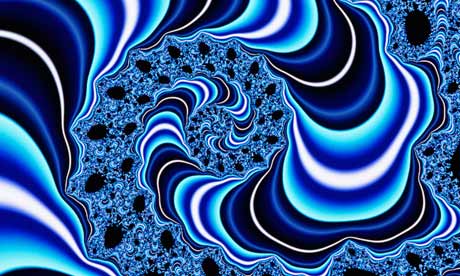
Fractals and their History The name "fractal" arises from the concept of a fractional dimension. What this means exactly is a difficult to say in simple language and we will simply try to give a feel for what fractals are and what sorts of behaviours they exhibit.
Generally fractals are the result of some which is procedure repeated again and again. One of the most basic examples of a fractal is obtained in the following way. Start off with an equilateral triangle which has sides of length 1. Now on each edge of the triangle, add a new equilateral triangle with sides of length 1/3. Now in the middle of each side of this new shape, add a triangle with sides of length 1/9. Continue this process, each time adding new triangles to each side which are 1/3 the size of the triangles added in the last stage. When you are done (infinitely many steps later!) you have the desired fractal.

Another interesting thing to note is that if we magnify our fractal along its edge, it looks the same, no matter how large the magnification is. This is another property typical of fractals. It turns out that fractals occur frequently in nature. This is often due to how nature performs its own iterations. For instance, as a tree grows, new branches grow from old branches. As these branches mature, they sprout new branches of their own. It is possible to implement a relatively simple algorithm on a computer and have it produce a remarkably accurate rendition of a tree. The shore line of a lake or large body of water also tends to exhibit fractal behaviour. One can tell by comparing aerial photos of shore lines to the contours of certain fractals whether or not the shore is natural.

Sources:
http://www.math.toronto.edu/mathnet/questionCorner/fracthist.html


